Leave Your Message
Engineered specifically to endure hot sulfuric electrolyte baths, high chloride ion concentrations, and continuous acidic cycles.
The global copper production landscape is experiencing unprecedented growth driven by the worldwide clean energy transition, electric vehicle (EV) manufacturing, renewable power infrastructure, and advanced microelectronics. In modern hydrometallurgical operations, modern cathode quality demands reach minimum purity standards of 99.9935% (ASTM B115 Grade 1 / Cu-ETP / Cu-OF). Achieving this standard consistently across million-ton annual production cycles depends entirely on the stability, thermal precision, and chemical resilience of tankhouse thermal management infrastructure—where the Nickel Seamless Tube serves as an irreplaceable backbone.
In standard electrolytic copper refining (ER) and solvent extraction-electrowinning (SX-EW) circuits, the electrolyte comprises aggressive concentrations of sulfuric acid ($\text{H}_2\text{SO}_4$, typically 160–210 g/L), dissolved copper ($\text{Cu}^{2+}$, 40–55 g/L), and elevated operating temperatures stabilized rigorously between 62°C and 68°C. Any fluctuation in thermal consistency leads to localized current density variations, nodulation, dendritic cathode growth, and severe anode passivation. Nickel seamless tubes (specifically UNS N02200 / Nickel 200 and UNS N02201 / Nickel 201) deliver unparalleled resistance to hot reducing acids, preventing costly metallic contamination that would otherwise degrade cathode purity and collapse electrical current efficiency.

High-purity wrought nickel alloy compositions eliminate iron, lead, and zinc leaching into the pregnant copper electrolyte, safeguarding 99.999% cathode grades.

Superior thermal conductivity (70.2 W/m·K at 20°C) facilitates rapid heat exchange in steam coils and plate heat exchangers with minimum surface scaling.

Cold-drawn seamless manufacturing avoids Heat Affected Zones (HAZ), eliminating weld seam intergranular attack under acidic redox stresses.
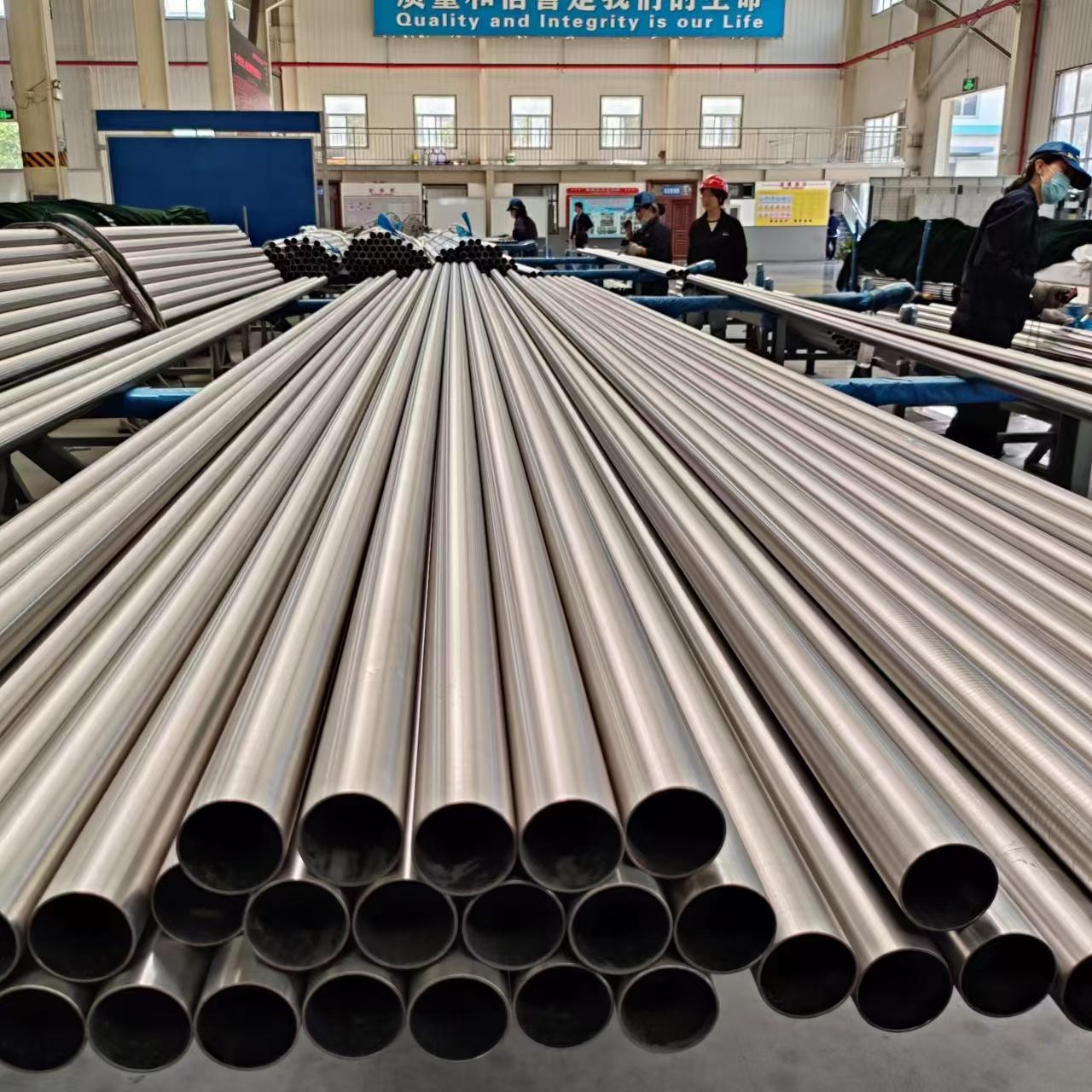
Electrolytic copper refining facilities operate in some of the world's most aggressive continuous industrial chemical atmospheres. Nickel seamless tubes undergo specialized precision fabrication for critical duty cycles within the tankhouse circuit:
Maintaining a strict temperature window (65°C ± 1.5°C) is mandatory to minimize electrolyte electrical resistance and ensure smooth copper electrodeposition. Nickel seamless tubes (ASTM B161 / ASTM B163) serve as shell-and-tube bundle tubing or submerged immersion steam bayonets. Unlike welded stainless steels (such as 316L or 904L) which suffer rapid stress corrosion cracking (SCC) due to chloride contamination in the process water, seamless nickel forms a robust passive oxide film ($\text{NiO}$) resilient to sulfuric acid hydrolysis.
Uniform flow distribution across hundreds of electrolytic cells prevents dead zones where copper ions deplete and impurity codeposition (such as Arsenic, Antimony, and Bismuth) accelerates. Seamless nickel manifolds and header spargers provide uniform fluid mechanics without internal weld beads that trigger turbulent erosion-corrosion.
Electrowinning cells produce substantial volumes of oxygen bubbles at the insoluble lead or DSA anodes, ejecting acidic aerosols into tankhouse atmospheres. Nickel seamless condensates and heat recovery tubing capture waste thermal energy from scrubbed acid vapors, maintaining mechanical strength and resist pitting under condensation cycles.
| Technical Parameter / Material | Nickel 200 (UNS N02200) | Nickel 201 (UNS N02201) | Titanium Gr. 2 (ASTM B338) | 316L Stainless Steel |
|---|---|---|---|---|
| Nickel Content (Min %) | 99.0% | 99.0% (Max 0.02% C) | N/A | 10.0 - 14.0% |
| Thermal Conductivity (W/m·K) | 70.2 | 79.3 | 21.9 | 16.3 |
| Corrosion Rate in Hot $\text{H}_2\text{SO}_4$ (<20%) | < 0.025 mm/year | < 0.025 mm/year | Passivated (Passive Oxide) | > 0.45 mm/year (Pitting risk) |
| Chloride Stress Corrosion Resistance | Immune | Immune | High | Highly Vulnerable |
| Standard Manufacturing Spec | ASTM B161 / B163 / B725 | ASTM B161 / B163 / DIN 17751 | ASTM B338 / ASME SB338 | ASTM A213 / A312 |
As the electrolytic copper industry accelerates toward decarbonization, modern tankhouses are modernizing their balance-of-plant systems. Three transformative technology vectors govern the demand for high-specification nickel tubing:
Baoji Special Steel Titanium Industry Co., LTD. is a joint-stock industrial enterprise specializing in the research, development, manufacturing and sales of titanium, nickel, zirconium and other metal pipes and metal composite materials. The company was founded in 1997, located in Shaanxi Baoji National High-tech Industrial Development Zone, the factory covers an area of 41,000 square meters.
Beyond electrolytic copper, our seamless nickel and titanium products empower demanding corrosive applications worldwide.

High-temperature alkali processing, organic chloride synthesis, and reactor heat cooling coils.
View Applications →
Electrolytic copper refining, nickel/cobalt SX-EW extraction, and pressure acid leaching (HPAL).
View Applications →
Decorative and functional electro-deposition baths, anode baskets, and acidic electrolyte heat systems.
View Applications →
Nuclear steam generators, renewable geothermal heat extractors, and green hydrogen water electrolysis.
View Applications →Stable product quality, integrity as the core of the business philosophy, trusted by world-class mining and metallurgical leaders.

Powering Global Mining Operations with Precision Titanium and Seamless Nickel Solutions under extreme continuous acid operation.

High-reliability nickel alloy tube integration for mega-scale hydrometallurgical refining circuits and continuous copper electrorefining tanks.

High-purity corrosion-proof piping and custom fabricated seamless bundles tailored for battery-grade cathode material extraction.
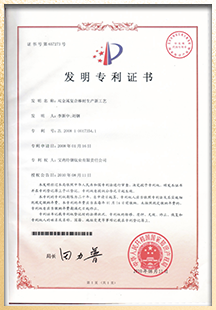
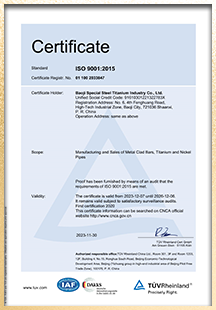
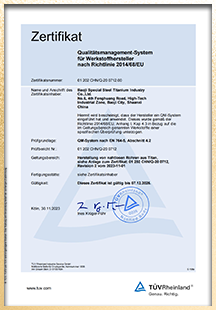
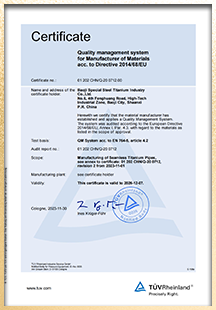
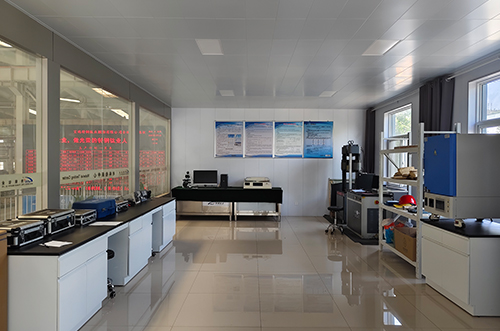
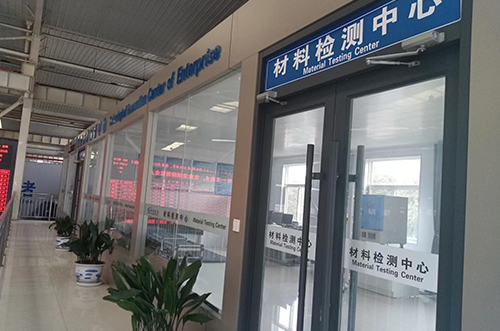
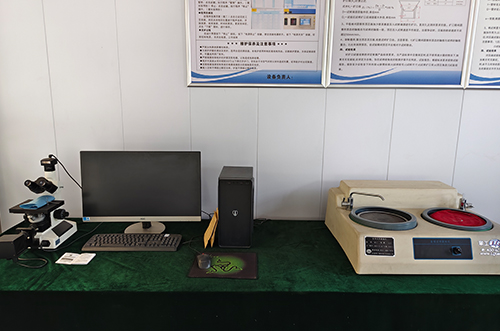
IATF 16949, CE, FMEA, PPAP, APQP, SPC and MSA 100% Rigorous Non-Destructive Testing
Key considerations for selecting nickel seamless tubing for electrolytic copper and hydrometallurgical operations.
Electrolyte baths contain concentrated $\text{H}_2\text{SO}_4$ at 65°C with potential chloride impurities. Welded tubes possess a metallurgical Heat Affected Zone (HAZ) susceptible to preferential galvanic attack, micro-fissures, and weld decay. Seamless cold-drawn nickel tubes provide uniform grain structures and isotropic mechanical strength, completely eliminating weld rupture risks.
Nickel 200 is commercially pure wrought nickel (99.0% min) with maximum carbon of 0.15%. Nickel 201 is low-carbon nickel (0.02% max C). While both perform exceptionally in electrolytic copper solutions, Nickel 201 is strictly specified when operating temperatures exceed 315°C (600°F) to prevent intergranular graphitization embrittlement during high-temperature thermal cycling.
Nickel maintains a high thermal conductivity of approximately 70.2 W/m·K—over four times greater than austenitic stainless steels (16.3 W/m·K). This enables rapid heat transfer from steam lines into the electrolyte, shrinking steam consumption, reducing thermal lag across cells, and preventing voltage spikes caused by temperature dips.
Our tubes comply strictly with ASTM B161 (Nickel Seamless Pipe and Tube), ASTM B163 (Seamless Nickel Condenser and Heat-Exchanger Tubes), ASME SB161/SB163, and DIN 17751. Every lot undergoes 100% Eddy Current Testing (ECT), hydrostatic pressure testing, dimensional verification, and PMI spectral chemical verification.
Explore our full line of corrosion-resistant solutions for global hydrometallurgical and chemical facilities.