Leave Your Message
Standard-compliant ASTM B338, ASTM B862, and ASTM B265 titanium welded pipes, sheets, and electrochemical components custom-manufactured for offshore installations and marine engineering plants.




Marine engineering represents one of the most mechanically and chemically aggressive operating environments on Earth. Submerged subsea piping systems, offshore oil and gas production platforms, naval defense vessels, and coastal seawater desalination installations face an unrelenting combination of chloride attack, biological fouling, microbially influenced corrosion (MIC), cavitational erosion, and severe mechanical cyclic fatigue. Under these demanding criteria, traditional copper-nickel (Cu-Ni 90/10 and 70/30) alloys, austenitic stainless steels (316L), and standard duplex stainless steels frequently experience premature failure, localized pitting, stress corrosion cracking (SCC), and pinhole leakage, leading to catastrophic downtime and astronomical lifecycle repair costs.
Titanium welding pipes, primarily fabricated under strict ASTM B862 (Standard Specification for Titanium and Titanium Alloy Welded Pipe) and ASTM B338 standards, have emerged as the definitive benchmark material for mission-critical marine applications. Titanium's exceptional resistance to seawater corrosion is governed by the instantaneous formation of a tenaciously adherent, dense, self-healing titanium dioxide (TiO₂) passive film when exposed to trace amounts of oxygen or moisture. This ceramic-like passive barrier remains completely inert in ambient and high-temperature seawater, providing virtually zero general corrosion rate (less than 0.0001 mm/year) across all ocean depths and flow velocities.

Unlike copper-based alloys limited to flow velocities below 3 m/s, titanium welding pipe tolerates fluid velocities exceeding 20 m/s and heavily silted or sandy seawater without cavitation or protective film stripping.

With a density of 4.51 g/cm³ (approx. 45% lighter than steel and 50% lighter than Cu-Ni alloys), titanium dramatically reduces top-side payload and structural deadweight on floating offshore FPSO and FLNG vessels.

Titanium eliminates corrosion allowances, cathodic inhibitors, and periodic replacement cycles, yielding a radically lower Total Cost of Ownership (TCO) across 30 to 50-year marine infrastructure design horizons.
The global transition toward deepwater exploration (exceeding 2,000 meters depth), floating liquefied natural gas (FLNG) processing, mega-scale SWRO (Seawater Reverse Osmosis) desalination, and stringent International Maritime Organization (IMO) emissions regulations has catalyzed a sharp spike in demand for marine-grade titanium welded piping. Historically restricted to high-cost aerospace and defense sectors, advanced continuous coil-to-pipe automated welding lines, high-frequency plasma arc welding (PAW), and laser-arc hybrid welding have made large-diameter titanium welded pipes commercially viable for mainstream commercial marine construction.
Commercial market insights indicate that the adoption of titanium welded pipes in offshore and marine engineering is expanding at a Compound Annual Growth Rate (CAGR) of over 7.8% from 2024 through 2032. Key market drivers include the rapid expansion of offshore wind farm subsea substations requiring maintenance-free cooling loops, the adoption of titanium in marine exhaust gas cleaning systems (scrubbers) to combat corrosive sulfurous washwater, and the replacement of failing copper-nickel ballast water treatment piping across commercial merchant fleets.
From offshore oil production platforms to advanced seawater desalination, discover how specialized titanium welded piping withstands the harshest oceanic stresses.
In high-pressure SWRO plants and multi-effect distillation (MED) evaporators, brine concentration can reach salinities exceeding 70,000 ppm TDS at elevated operating temperatures and pressures up to 85 bar. Titanium Grade 2 welded pipe (ASTM B862) is utilized extensively in high-pressure seawater manifold headers, energy recovery device (ERD) interconnecting loops, and brine reject lines. Titanium's complete immunity to pitting and crevice corrosion under stagnant, warm brine makes it far superior to super duplex stainless steels (such as 2507), eliminating localized crevice attack beneath O-rings and Victaulic couplings.
Offshore topside systems—including firewater deluge systems, seawater cooling loops for gas compressors, and drainage caissons—must maintain 100% operational readiness without dry-pipe scaling or wall-thinning corrosion. Titanium Grade 5 (Ti-6Al-4V) and Grade 9 (Ti-3Al-2.5V) welded and seamless pipes are widely deployed in offshore catenary risers, subsea wellhead jumpers, and topside piping. Titanium's low elastic modulus provides superior compliance in dynamic wave-induced fatigue environments, absorbing subsea hydrodynamic stresses without structural micro-cracking.
Under IMO MARPOL Annex VI regulations, marine exhaust scrubbers process high-temperature (up to 350°C) combustion gases mixed with aggressive seawater sprays containing sulfurous acid (H₂SO₃), sulfuric acid (H₂SO₄), and hydrochloric acid (HCl), driving fluid pH down to 1.5–2.0. Titanium Grade 2 and Grade 7 (palladium-stabilized) welded pipes and exhaust bypass ducts provide absolute corrosion resistance against hot acid condensates where high-nickel superalloys (such as Alloy 276 and 254SMO) experience localized weld-decay and chloride stress corrosion.
In naval defense, weight reduction, non-magnetic signatures, and acoustic dampening are crucial. Titanium welded piping provides low magnetic permeability, high shock absorption during explosive pressure waves, and deep-sea hyperbaric crush resistance for submarine ballast blow systems, torpedo ejection conduits, hull-penetrating seawater intake lines, and auxiliary propulsion cooling systems.
| Performance Metric | Titanium Welded Pipe (Gr. 2 / Gr. 5) | Cu-Ni 90/10 (C70600) | Super Duplex 2507 (UNS S32750) | Marine SS 316L (UNS S31603) |
|---|---|---|---|---|
| Density (g/cm³) | 4.51 (Ultra-lightweight) | 8.94 (Heavy) | 7.80 (Heavy) | 8.00 (Heavy) |
| Corrosion Rate in Seawater | < 0.0001 mm/yr (Zero attack) | 0.02 - 0.05 mm/yr | < 0.005 mm/yr (Risk of crevice) | 0.05 - 0.20 mm/yr (Severe pitting) |
| Max Velocity Limit (m/s) | > 20 m/s (No cavitation) | 3.5 m/s (Erosion risk) | 12 m/s | 4.0 m/s |
| Pitting Resistance (PREN) | Immune (TiO₂ oxide passivity) | N/A (Susceptible to bio-fouling) | 42 - 45 | 23 - 25 (High Failure Risk) |
| Service Life Expectancy | 40 - 50+ Years | 10 - 15 Years | 15 - 25 Years | 3 - 8 Years |
| Maintenance Requirements | Zero Scheduled Corrosion Repairs | Periodic Flushing & Replacement | Frequent Inspection for Crevice Attack | Constant Patching & Replacements |
The manufacturing of titanium welding pipes for hyperbaric marine service requires stringent metallurgical control. Titanium is an active reactive metal that readily absorbs interstitial impurities—namely oxygen, nitrogen, hydrogen, and carbon—at temperatures above 400°C (752°F). Interstitial contamination results in severe embrittlement and loss of ductility in the heat-affected zone (HAZ), compromising pipe integrity under cyclic deep-sea hydrostatic pressure.
Our automated production processes utilize advanced automated Gas Tungsten Arc Welding (GTAW/TIG) and Plasma Arc Welding (PAW) within positive-pressure inert atmospheres. Custom-engineered trailing shields and internal root purge chambers deliver 99.999% ultra-pure Argon gas shielding, ensuring silvery, straw-free weld seams conforming to AWS D10.6 (Recommended Practices for Gas Tungsten Arc Welding of Titanium Piping and Tubing) and ASME Boiler and Pressure Vessel Code Section IX qualification procedures.
Every single length of titanium welded pipe manufactured for offshore and marine applications undergoes rigorous testing to eliminate subsurface defects, porosity, or micro-cracks:
A world-class industrial enterprise pioneering research, advanced manufacturing, and engineering fabrication of titanium, nickel, zirconium, and high-performance metallic piping systems since 1997.
Baoji Special Steel Titanium Industry Co., LTD. is a joint-stock industrial enterprise specializing in the research, development, manufacturing, and sales of titanium, nickel, zirconium, and other specialized metal pipes and metal composite materials. The company was founded in 1997, located in Shaanxi Baoji National High-tech Industrial Development Zone ("China Titanium Valley").
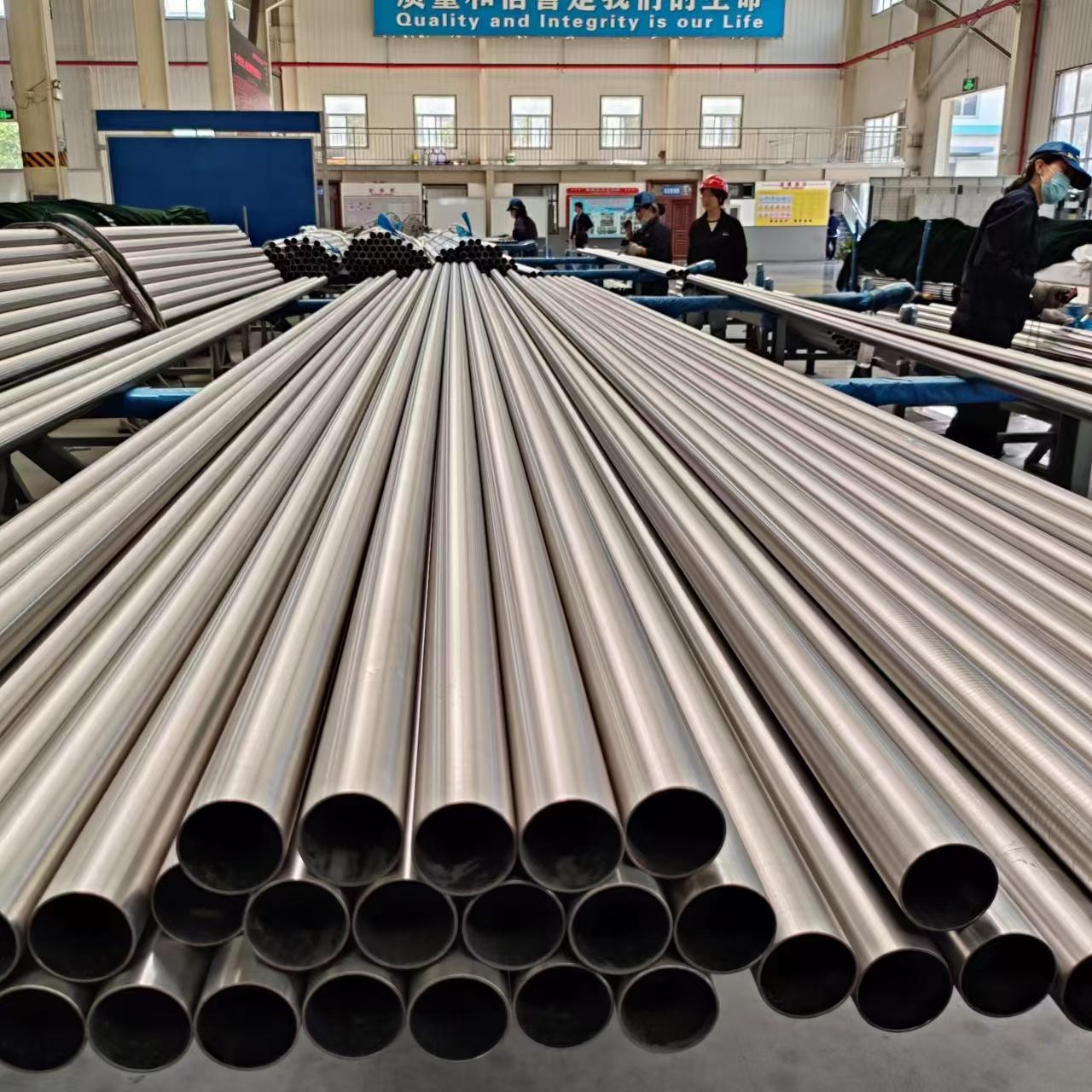
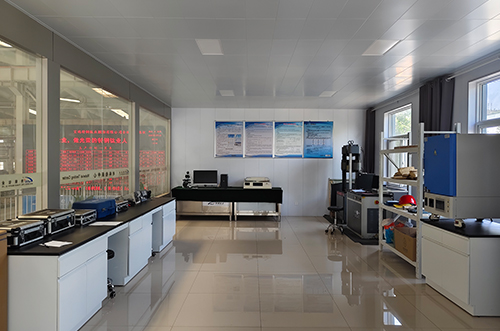
With an extensive manufacturing footprint covering an area of 41,000 square meters, our facility integrates high-precision rolling mills, continuous vacuum annealing furnaces, automated orbital welding systems, and comprehensive multi-axis testing centers to deliver unparalleled titanium piping products to engineering contractors across the globe.

Severe acid chlorination & offshore processing lines.

High-pressure autoclave piping and slurry transfer.

Electrochemical hull protection & chlor-alkali systems.

Subsea cooling circuits & LNG vaporizers.
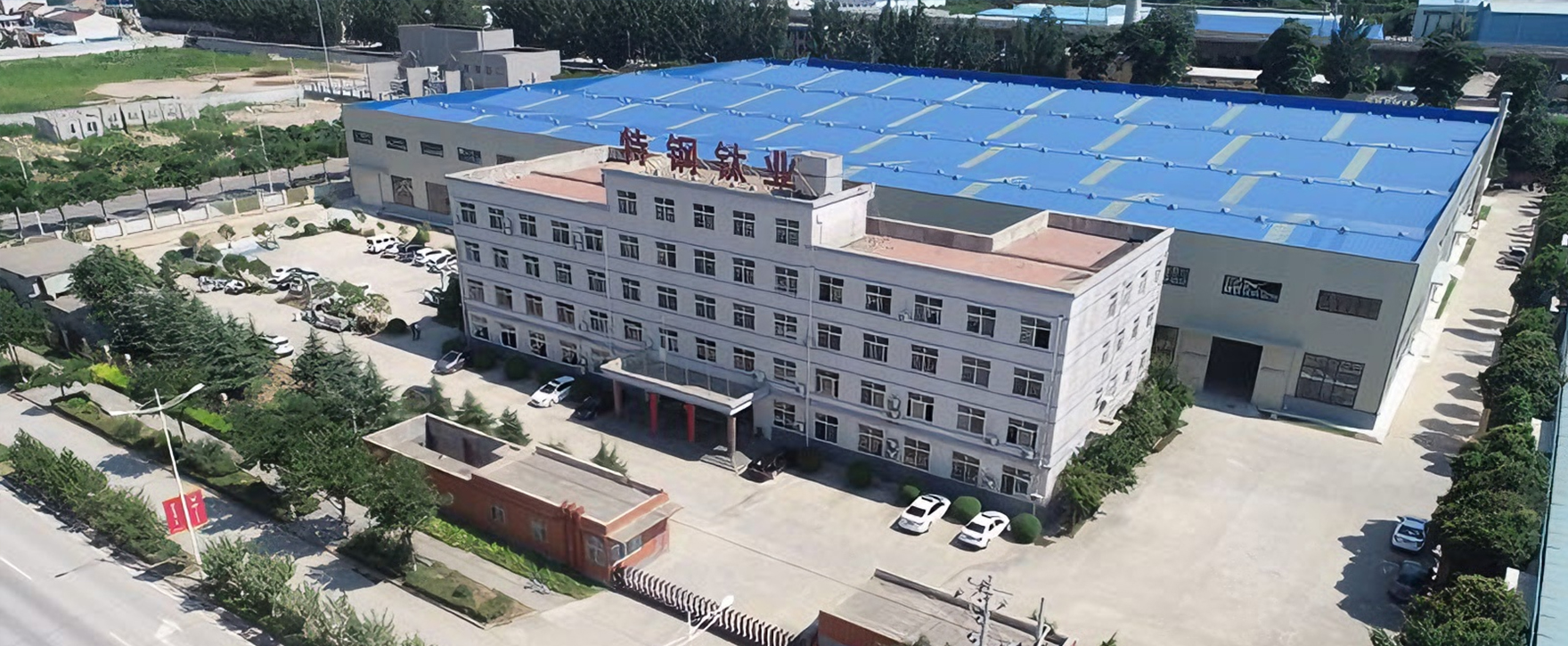
IATF 16949, CE, FMEA, PPAP, APQP, SPC, and MSA 100% Tested Production Management Since 1997.
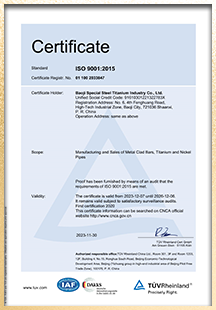
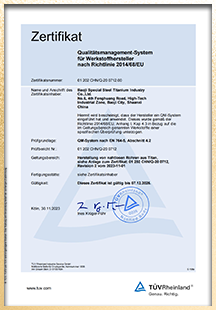
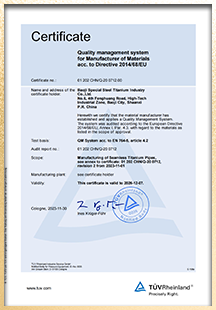
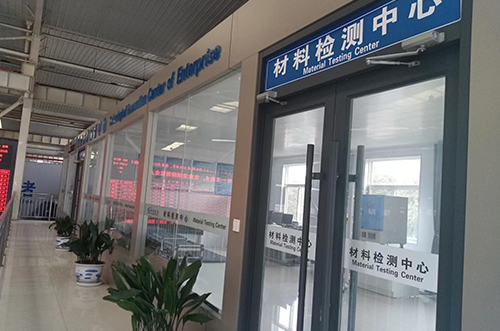
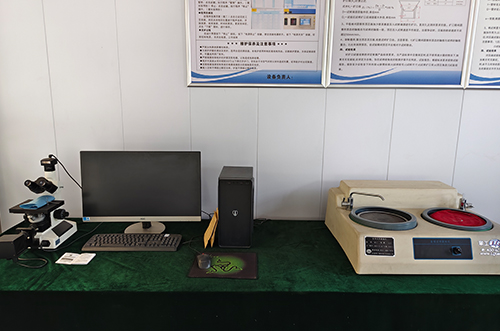
Stable product quality, integrity as the core of the business philosophy, trusted by world-leading industrial enterprises for critical marine and industrial metallurgy projects.

Powering Global Mining & Offshore Electrochemical Operations with Precision Titanium Solutions.

High-corrosion titanium welded piping networks for extreme chemical and heavy metallurgy applications.

Titanium piping and cathode modules for hydrometallurgical energy metal processing systems.
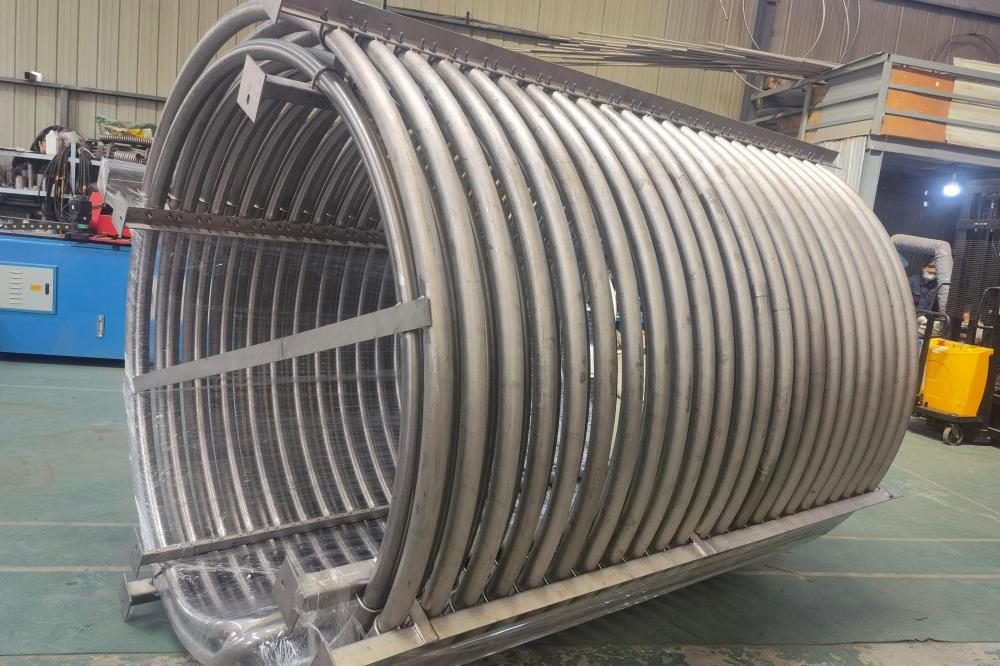
High-integrity titanium reactor piping and heat exchangers for global chemical complexes.
Key engineering considerations for specification, welding, galvanic insulation, and maintenance of titanium piping in offshore environments.
A: ASTM B862 Grade 2 titanium welded pipe offers significant economic and dimensional advantages for large diameters (typically NPS 4" to 48" and above). Advanced automated PAW/TIG welding processes produce welded titanium pipes with uniform wall thickness, precise concentricity, and virtually 100% joint efficiency equal to seamless pipe, while reducing material lead times and manufacturing costs by up to 35% compared to heavy-wall extruded seamless tubes.
A: Because titanium is more electrochemically noble than carbon steel, stainless steel, and copper alloys, direct metallic contact in conductive seawater can accelerate the galvanic corrosion of the less noble partner. Marine engineers resolve this by installing dielectric isolation flange kits (consisting of G10/FR4 insulating gaskets, sleeves, and washers), using rubber-lined valves, or deploying sacrificial anodes strategically adjacent to the junction.
A: When welding titanium pipe according to AWS D10.6, the torch shielding gas, trailing shield, and root purge must maintain high-purity argon with an oxygen content below 20 ppm and a dew point below -50°C. Shielding must remain in place until the weld metal cools below 400°C (752°F) to prevent surface oxidation, which appears as unacceptable blue or white chalky scaling.
A: While titanium does not exhibit the natural toxic cuprous leaching of copper-nickel alloys to repel marine organisms, barnacles, algae, and mussels that attach to titanium surfaces cannot penetrate or disrupt the tenacious TiO₂ passive oxide film. Biofouling can be removed through high-pressure water jetting or continuous chlorination without causing crevice corrosion under micro-organism colonies.
Browse our full range of certified titanium welded pipes, titanium plates, nickel pipes, and electrochemical anodes/cathodes tailored for offshore maritime projects.